
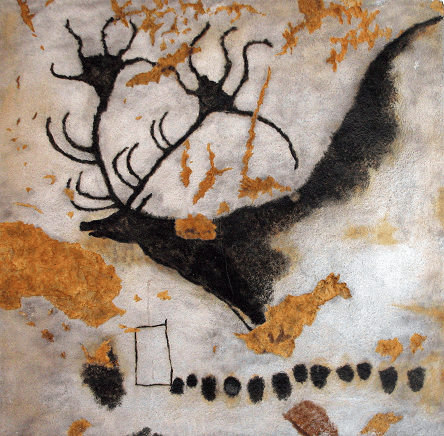
Mathematical proof and proof beyond a shadow of a doubt are two different things. The sign of the beast 666 is actually a reference to the 18-year lunar eclipse cycle. The same thing appears some 17,000 years ago at the Lascaux cave in France. There are 18 prongs on the image of a deer, plus a code of 13 dots underneath. A female month is about 28 days and a simple multiplication gives us 28 x 13 = 364 days or about one year. It is not likely anybody is doing a ‘simple’ multiplication; but rather, by observing landmarks against objects in the sky. A year by the stars (sidereal year) is less than a tenth of a second different than a solar year so they do indeed have an astronomical clock. Notice that the dots are in-groups of two, that is 2 x 6 + 1 = 7, a reference to the bit dipper. Proof by dots!
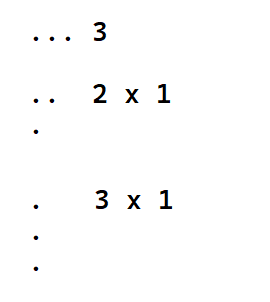
Definition: A partition p(n) is a representation of positive integer as a sum of positive integers such as this graphical representation of p(3) = 3,
Euler's Partition Theorem: The number of partitions of n in which all parts are odd equals the number of partitions of n which are distinct. For p(7) = 15, there will be five of each.

7		odd, distinct
6 + 1		distinct
5 +2		distinct
5 + 1 + 1	odd
4 + 3		distinct
4 + 2 + 1	distinct
4 + 1 + 1 + 1
3 + 3 + 1	 odd
3 + 2 + 2
3 + 1 + 1 + 1 + 1 odd
2 + 2 + 2 + 1
2 + 2 + 1 + 1 + 1
2 + 1 + 1 + 1 + 1 + 1
1+1+1+1+1+1+1	odd

climatehoax.ca@gmail.com
 Ape Town